

| MYTHs | FACTs |
|---|---|
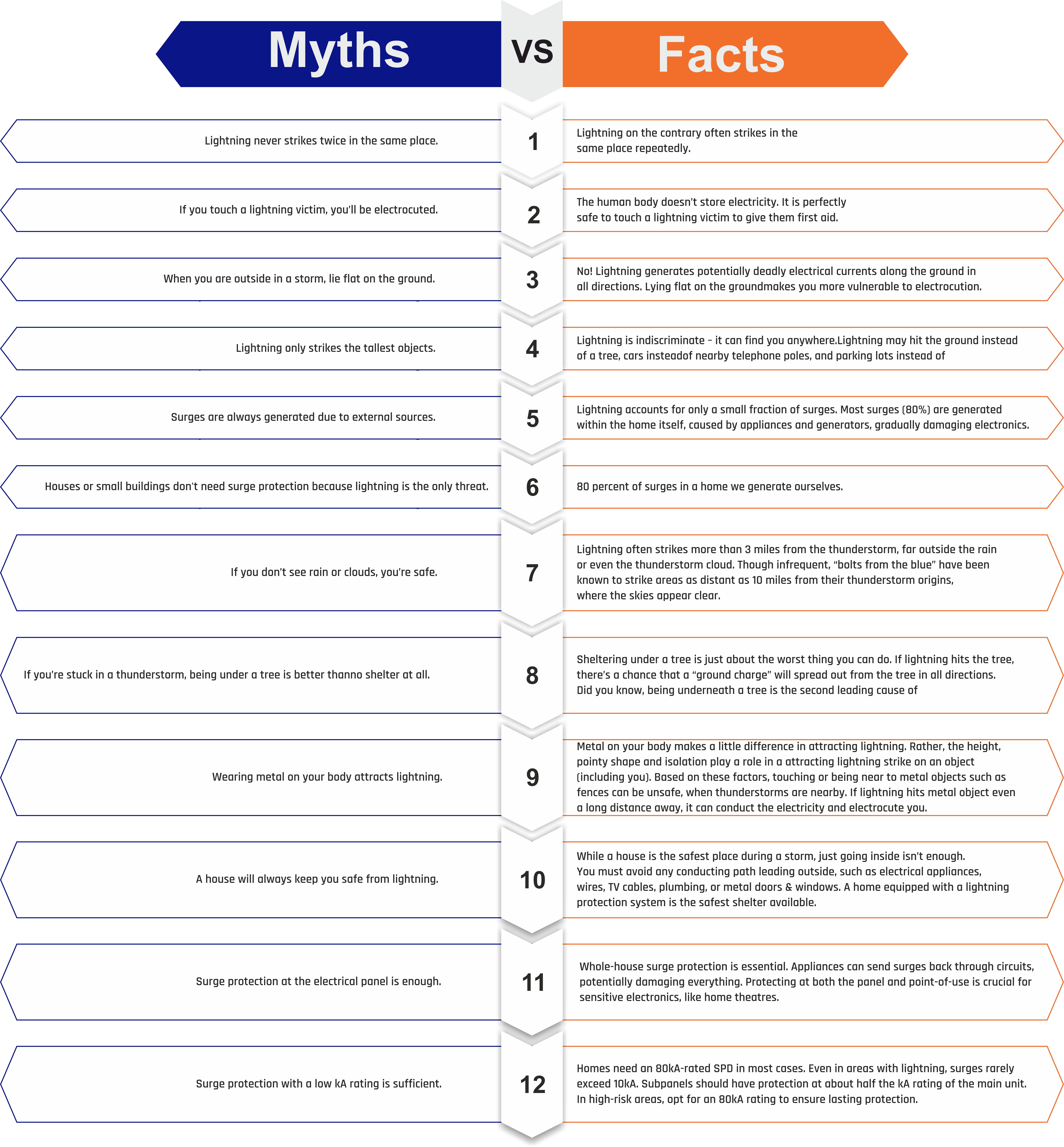
| Lightning never strikes twice in the same place. |
Lightning on the contrary often strikes in the same place repeatedly. |
| Lightning only strikes the tallest objects. |
Lightning is indiscriminate – it can find you anywhere. Lightning may hit the ground instead of a tree, cars instead of nearby telephone poles, and parking lots instead of buildings. |
| If you’re stuck in a thunderstorm, being under a tree is better thanno shelter at all. | Sheltering under a tree is just about the worst thing you can do. If lightning hits the tree, there’s a chance that a “ground charge” will spread out from the tree in all directions. Did you know, being underneath a tree is the second leading cause of |
| If you don’t see rain or clouds, you’re safe. | Lightning often strikes more than 3 miles from the thunderstorm, far outside the rain or even the thunderstorm cloud. Though infrequent, “bolts from the blue” have been known to strike areas as distant as 10 miles from their thunderstorm origins, where the skies appear clear. |
| When you are outside in a storm, lie flat on the ground. | No! Lightning generates potentially deadly electrical currents along the ground in all directions. Lying flat on the ground makes you more vulnerable to electrocution. |
| If you touch a lightning victim, you’ll be electrocuted. | The human body doesn’t store electricity. It is perfectly safe to touch a lightning victim to give them first aid. |
| Wearing metal on your body attracts lightning. | Metal on your body makes a little difference in attracting lightning. Rather, the height, pointy shape and isolation play a role in a attracting lightning strike on an object (including you). Based on these factors, touching or being near to metal objects such as fences can be unsafe, when thunderstorms are nearby. If lightning hits metal object even a long distance away, it can conduct the electricity and electrocute you. |
| A house will always keep you safe from lightning. | While a house is the safest place during a storm, just going inside isn’t enough. You must avoid any conducting path leading outside, such as electrical appliances, wires, TV cables, plumbing, or metal doors & windows. A home equipped with a lightning protection system is the safest shelter available. |
We offer LPS, SPD, Earthing Systems, Lightning Warning Systems, Exothermic Welding, Servo Stabilizer and Power Quality Auditing.
GPS INDIA TECHVENTURES PVT LTD
1298/17, Ground Floor, Sector 17
Faridabad, Haryana – 121 002, INDIA
Marketing Office: Bengaluru, Chennai, Ghaziabad, Kolkata
Works 1: Kanniyakumari, Tamil Nadu
Works 2: Faridabad, Haryana
© 2025 GPS . All rights reserved | Privacy Policy Designed & Developed by Thinksmiths Software Services Pvt. Ltd.